A paramilitary organization (also listed as quasi military) is a semi-militarized force whose organizational structure, tactics, training, subculture, and (often) function are similar to those of a professional military, but is not formally part of a country's armed forces.


Legality
Under the law of war, a state may incorporate a paramilitary organization or armed agency (such as a national police or a private volunteer militia) into its combatant armed forces. The other parties to a conflict have to be notified thereof.
Military compared to paramilitary
Though a paramilitary is not a military force, it is usually equivalent to a military's light infantry force in terms of intensity, firepower, and organizational structure. A paramilitary may also commonly fall under the command of a military, even despite not being part of the military or play an assisting role for the military in times of war. Paramilitary forces can also include private military company missions.
Types
Depending on the definition adopted, "paramilitaries" may include:
Irregular military
- Irregular military forces: militias, freedom fighters, guerrillas, insurgents, terrorists, etc.
Auxiliary forces
- The auxiliary forces of a state's military: national guard, presidential guard, republican guard, state defense force, civil air patrol, home guard, royal guard, and imperial guard.
- Some police forces or auxiliary police: Indonesia's Mobile Brigade Corps (Brimob), Detachment 88, India's Assam Rifles, Central Reserve Police Force, Border Security Force, Hong Kong Police Force, etc.
Political
- Armed, semi-militarized wings of existing political parties:
- those of the Weimar Republic; which was very common during this period, when every political party in strife-torn Germany had their own; examples include:
- the Nazi Party's Sturmabteilung.
- the Monarchist German National People's Party's Der Stahlhelm.
- the Communist Party of Germany's Parteiselbstschutz.
- Sinn Féin's Irish Republican Army.
- Hamas's Izz ad-Din al-Qassam Brigades.
- the African National Congress's Umkhonto we Sizwe.
- those of the Weimar Republic; which was very common during this period, when every political party in strife-torn Germany had their own; examples include:
Law enforcement
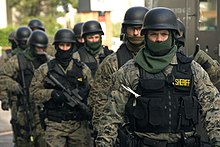
- Semi-militarized law enforcement personnel within normal police forces, such as SWAT teams in the United States and various police tactical units in other countries.
- Gendarmeries, such as Egyptian Central Security Forces and Russia's National Guard.
- Border guards, such as Russia's Border Guard Service, Australian Border Force, India's Border Security Force, Bangladesh's Border Guards Bangladesh and Turkey's Village guards.
- The United States' Federal Protective Forces and NASA's Emergency Response Teams.
- Security forces of ambiguous military status: internal troops, railroad guards, or railway troops.
Government agencies
- CIA Special Activities Center.
- DEA Special Response Team.
Home guards
- Volunteer Defence Corps, such as Volunteer Defence Corps in Thailand, Volunteer Defence Corps in Australia, Shanghai Volunteer Corps, and Royal Hong Kong Regiment.
Civil defence
- The fire departments of many countries and locales, although unarmed, are often organized in a manner similar to military or police forces.
- The Belgian Civiele Bescherming and Singapore Civil Defence Force.
- The Australian State Emergency Service.
| This article uses material from the Wikipedia article Metasyntactic variable, which is released under the Creative Commons Attribution-ShareAlike 3.0 Unported License. |